
How fast and how many job functions can AI actually access, accelerate, or replace?
To answer that, I have scored every role across five dimensions drawing on my experience across four very different industry sectors and what I have observed during my career stints. I have then mapped the results onto four axes to visualize how deploying AI can bring in gains in productivity, innovation or accelerate future cash inflows to an earlier period (NPV pull-in).
The framework reveals roles that AI can enable rapid uptake in productivity versus those requiring longer ramp times but offering transformational innovation potential.
Key Insights:
- Roles are mapped on productivity gain vs. innovation potential, with bubble size showing NPV pull-in (cash flow acceleration)
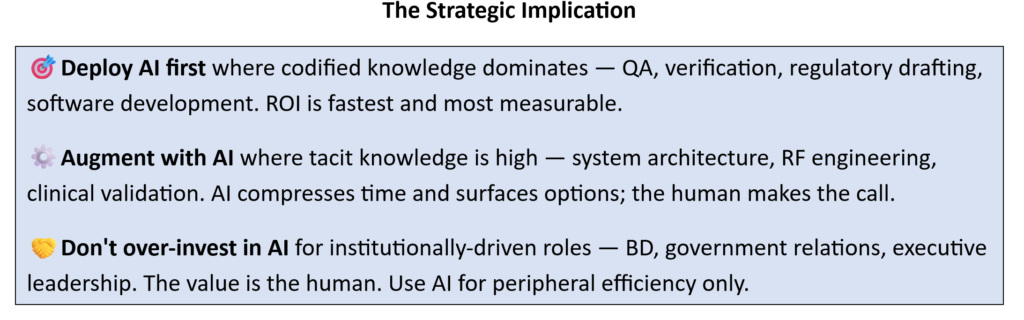
- High automation: QA engineers, Software Engineers, Data Analysts (codified knowledge, measurable outputs)
- Limited automation: Directors, System Architects, Product Managers (tacit/institutional knowledge dependent)
⏱ Time to Meaningful Productivity: How quickly can an AI-assisted practitioner reach productive output? Roles with short ramp times — where tasks are well-defined and outputs are measurable — score higher. A QA engineer running AI-generated test suites is productive in days; a chip architect validating a micro-arch decision takes quarters.
💡Time to True Innovation: Beyond productivity lies a harder question: can AI expand the creative frontier of a role? I have scored roles on how quickly AI can meaningfully shift what is possible — not just faster, but genuinely new. AI/ML diagnostic developers and micro-architects score highest here; project managers and QA engineers score lowest.
📋Codified Knowledge Rank | Manuals · Rules · SOPs · Standards
Knowledge that has been written down, structured, and made explicit. It lives in documentation, specifications, regulations, and repeatable processes. AI was essentially built for this. Roles that operate primarily from documented rules (regulatory submissions, test plans, RTL standards) are highly automatable. High Codified Knowledge Rank = High AI leverage.
Example roles:
- QA Engineer writing test plans from specs ·
- Regulatory Affairs drafting 510(k) submissions ·
- Verification Engineer generating UVM testbenches from design documents
AI impact: Very High. Agentic tools can read, reason over, and generate codified knowledge at scale. Productivity gains of 40–80% are achievable and measurable quickly.
🧠Tacit Knowledge Rank | Intuition · Sensory judgment · Experience
Knowledge that lives in the body and mind of the practitioner — built through years of doing. It cannot be fully written down — is the hardest for AI to replicate. An analog circuit designer “feels” a layout. A clinical engineer reads a patient population intuitively.
Example roles:
- Analog/Mixed-signal Engineer tuning a PLL
- Senior System Architect analyzing performance requirements based on intended use case
- Experienced BD leader reading a room in a government briefing
AI impact: Moderate. AI can accelerate adjacent tasks and surface patterns but cannot replicate the judgment itself. It augments the expert rather than replacing the expertise.
🏛 Institutional Knowledge Rank | Local context · Politics · Relationships
Knowledge that exists in the history, culture, and relationships of a specific organization or ecosystem. Who to call, what really happened in that program, which stakeholder actually holds the veto. AI has no access to any of this.
Example roles:
- Medical Affairs Advisor navigating PMA with FDA
- Director of Engineering navigating organizational politics
- Defense markets, attending a government agency meeting for discerning next generation program requirements
AI impact: Low. The core value of these roles is irreplaceable human capital. AI can handle peripheral tasks but cannot substitute for trust, access, or organizational context.
A follow-on post will delve into Economics of Photonic Startup in the age of AI, a real-world scenario of how it played out.